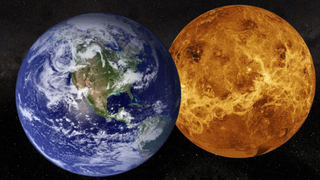
Scientists have put paid to the idea that life could have ever existed on Venus. This disappointing revelation comes from the fact that it appears that water oceans could never have existed on the surface of our neighbouring planet.
Venus is often called Earth’s “evil twin” because, despite being a virtual hell today, it is believed that our neighbour was very similar to our planet in its ancient past.
This new research suggests that Venus was always a hellish planet, and despite its distance from the Sun and similar mass to Earth, it was never our planet’s twin in other respects.
This finding is the work of a team of scientists from the University of Cambridge. They arrived at their conclusions by examining the chemical composition of Venus’ atmosphere.
The team’s research, published in the journal Nature Astronomy, could have implications beyond the solar system. The findings could help astronomers select which planets outside the solar system, or “exoplanets”, are most habitable.
“Even though it’s the closest planet to us, Venus is important for science because it gives us the unique opportunity to explore a planet that has evolved very differently from our own, right at the edge of the habitable zone,” Tereza Constantinou, a PhD student at Cambridge’s Institute of Astronomy and team leader, said in a statement.
Alternate history of Venus
Currently, Venus’s surface temperature is about 1,000 degrees Fahrenheit (500 degrees Celsius), hot enough to melt lead.
If that wasn’t enough, the second planet from the sun also has clouds of sulfuric acid.
Despite these extreme conditions, many scientists believe Venus may have been habitable billions of years ago. Most investigations into this question have focused on water, which we understand to be a key ingredient for life.
There are two primary hypotheses about how Venus evolved over the past 4.6 billion years.
One idea suggests the planet was once cool enough to host liquid water. According to this theory, this situation changed due to a greenhouse effect driven by volcanic activity.
As a result, Venus gradually warmed, reaching the point that it could no longer hold water in a liquid state.
The second theory suggests that Venus never had liquid water because the planet was “hot from birth.” The team’s results seem to favor this waterless alternative history.
“Both of these theories are based on climate models, but we wanted to take a different approach based on observations of Venus’s current atmospheric chemistry,” Constantinou said. “In order for Venus’ atmosphere to remain stable, any chemicals being removed from the atmosphere must also be returned to it, because the interior and exterior of the planet are in constant chemical communication with each other.”
Specifically, the researchers looked at how quickly water, carbon dioxide and carbonyl sulfide are lost from Venus’s atmosphere and, thus, how quickly they must be replenished from the planet’s interior through volcanism.
By moving material from the planet’s surface to its mantle and releasing it as a gas, volcanically driven magma signals the interiors of these worlds.
Earth’s volcanic eruptions consist mostly of steam because our world’s interior is water-rich. The team found that Venus’ volcanic gases, on the other hand, are no more than 6% steam.
From these dry eruptions, the researchers inferred that Venus’s interior is so dry that there may never have been enough water to supply oceans on the planet’s surface.
“We won’t know for sure whether life could have existed on Venus until we send a probe later this decade,” Constantinou said. “But given that it probably never had oceans, it’s hard to imagine that Venus could have ever had life like Earth, which requires liquid water.”
Humanity may not have to wait long to answer this question. NASA’s Davinci mission is expected to launch in June 2029, and will arrive at Venus two years later.
Once it orbits the hellish planet, Davinci will drop a probe into its atmosphere, collecting crucial data. While the probe isn’t designed to survive after landing, there’s a chance it could catch a 7-second glimpse of Venus’s surface.